- Topic
- Research
- Reading time
- 9 min
- Written by
- Misha PetrovFounder, SEENMETRIC
- Published
- 2 November 2026
GuidesResearch
What AI tells pet owners when they ask for a vet
More pet owners are asking ChatGPT and Google's AI which vet to use. We checked what those tools say about 3,371 Australian clinics, and the practices that get recommended have a few simple things in common.

As featured in Pet Industry NewsThis is the full version of our research, with all charts and the complete methodology.
Photo: Tima Miroshnichenko / Pexels
On this page
Picture a family that has just moved to Ballarat with a new puppy. Rather than scrolling a map, they type a question into Google's AI Mode: "Can you recommend a good vet in Ballarat?" We asked exactly that in early October.
The short version
- Reviews count more than stars. Clinics with 200 or more Google reviews were named 99 per cent of the time; clinics with fewer than 50, 37 per cent.
- The AI repeats what your clients say. Reviews or ratings came up in 98 per cent of answers, and three in four said something about how the team treats people and their animals.
- Each AI reads something different. Gemini leans on Google Maps listings and ChatGPT on clinic websites, so the three systems agreed on roughly half the clinics they named.
- Simple housekeeping gets you recommended. Clinics that had taken charge of their free Google listing were recommended 79 per cent of the time; clinics that had not, 17 per cent. Clinics open on Saturdays were recommended 88 per cent of the time; those closed on Saturdays, 48 per cent.
- Most of it can be fixed this month. Ask every client for a review, fill in your Google profile, and put weekend and after-hours details on your website.
Want to know where your business stands? Our Standard Audit reads up to 40 pages of your site, looks at up to 300 Google searches you already show up for, sets you against up to three local competitors, and shows what ChatGPT says when customers ask up to 5 questions. A$249 one-off, delivered in two business days, no access to your site needed.
Get my Standard AuditThe answer reads like advice from a neighbour who has lived there for years. It names five clinics and says something about each one. One is "great for people who have just moved to the area" and opens on Saturdays. Another has "a dedicated after-hours switch line". A third runs a preventative health membership that "can provide significant discounts" on routine care.
What the answer leaves out is a Ballarat clinic with a perfect 5.0 rating from 204 Google reviews. The five that were named had between 245 and 431 reviews each. As far as the AI was concerned, the best-rated clinic in town had not built up enough of a reputation to mention.
We saw the same thing almost everywhere we looked. In the first days of October, SEENMETRIC, the Sydney firm I run, pulled 3,371 Google listings for vet clinics across every state and territory. We then asked ChatGPT, Gemini and Google AI Mode the questions a pet owner asks, in 60 suburbs and towns from Cairns down to Hobart, and read all 360 answers.
If you were hoping the AI has developed a view on veterinary medicine, it hasn't. "An AI assistant doesn't have an opinion about your clinic," says Dima Smetanin, co-founder of SEENMETRIC. "It repeats what it can find about you: your reviews, your hours, what clients say about your team. Pet owners have always asked for a recommendation. What has changed is who they ask."
Reviews count more than stars
For the 256 active clinics located in the 60 places we tested, we checked one simple thing: was the clinic named in at least one of the six AI answers for its area?
Among clinics with fewer than 50 reviews, 37 per cent were named. Between 50 and 199 reviews, 88 per cent. At 200 or more, 99 per cent. In 57 of the 59 places with more than one clinic, the clinic with the most reviews was named.
The star rating, which is what most practices worry about, mattered far less. Clinics at 4.8 or above were named no more often than clinics at 4.5 to 4.7.
"A 4.6 with 400 reviews looks like a safer recommendation than a 5.0 with 40," Smetanin says. "For a practice with a loyal client base and few reviews, simply asking every client is the easiest place to start."
Nationally, three in 10 active clinics still have fewer than 50 Google reviews. That is a lot of practices whose reputation lives mainly in the memories of their clients.

What the AI says about you
We read the 180 answers to "Can you recommend a good vet?" and tallied the reasons the AI gave for each clinic. Almost none of them were clinical.
Reviews or ratings came up in 98 per cent of answers. Three in four said something about how the team treats people and their animals, usually in the words clients use in reviews: "compassionate", "attentive", "friendly". About the same share mentioned after-hours or emergency cover, seven in 10 mentioned opening hours, and nearly half said whether the clinic is open on weekends. Surgical capability, equipment and the qualifications of the vets barely featured, except as items in a list of services.
The less flattering material gets passed on too. In an answer about Parramatta, Google's AI noted that "a few clients have noted that advanced surgical quotes can run high". Gemini, advising a puppy owner on the Central Coast, warned that one clinic was "closed on Sundays, so be sure to book ahead during the week". Neither remark is wrong. Neither is what the clinic would have chosen to lead with.

"Your reviews now speak for you, whether you wrote them or not," Smetanin says. "When clients mention a nurse by name or say the costs were explained clearly, that detail can end up in the answer a new client reads."
The editorial team at VetCompare, a site where pet owners compare quotes from clinics, sees the search from the other end. "Price is usually what starts the search, but it's rarely the only thing that decides it," the team says. "People want to know what's included in a quote, whether the clinic can see them soon, and what other owners say about how their pet was treated. A clinic that explains its costs clearly wins a lot of trust."
Each AI reads something different
If you have checked ChatGPT once, found your clinic mentioned and relaxed, it is worth checking the other two. Asked about the same suburb, the three systems agreed on roughly half the clinics they named. The rest were mentioned by one or two and left out by the others.
The reason is mundane: they read different things. Gemini linked to Google Maps listings in 97 per cent of its answers and to almost nothing else. ChatGPT linked to clinic websites in 89 per cent of answers and to directories and review sites in 35 per cent. Google's AI Mode spread itself around, citing Google listings in 86 per cent of answers, clinic websites in 32 per cent and online booking pages in 30 per cent.
So your Google profile matters, your website matters, and if the opening hours on one disagree with the opening hours on the other, somebody is going to be told the wrong thing with great confidence.

The housekeeping behind a recommendation
We also compared the clinics that were named with the ones that weren't. The differences had nothing to do with medicine. They were the sort of thing a practice manager could fix on a quiet afternoon.
Clinics that had claimed their Google profile, meaning the practice has verified it and can edit it, were named 79 per cent of the time. The 23 unclaimed ones, 17 per cent. Clinics open on a Saturday were named 88 per cent of the time, against 48 per cent for those that were closed. Profiles with at least 10 photos were named 90 per cent of the time; with fewer, 32 per cent.
Busy clinics tend to have all of these things anyway, so claiming a profile won't by itself get you recommended. Each one does give the AI one more fact to work with, and a surprising number of practices are giving it very little. Of 2,785 active clinic listings nationally, a quarter have fewer than 10 photos and a quarter have no business description at all. One in 14 has never been claimed, which means nobody at the practice can correct the hours or reply to a review.

The websites have their own gaps, mostly around turning a recommendation into a booking. We checked 1,732 independent clinic websites. On Google's mobile speed test, 85 per cent took more than four seconds to show their main content. On fewer than a third could we find a recognised online booking system. And only four per cent said, on the pages we looked at, that they were taking new clients. (We checked the homepage and up to 15 linked pages, so some of these features may exist deeper in a site. A new client is unlikely to go looking.)

"Owners want to know opening hours, what happens after hours, and roughly what things cost," says the VetCompare editorial team. "When that information is missing or out of date, they move on to the next clinic. It's not a marketing problem, it's a housekeeping one."
Five things you can do this month
- Ask every client for a review. A card at the counter works, or a text after the consult with a direct link. Ask everyone, including the clients you suspect were unhappy, and don't offer anything in return.
- Claim your Google profile and fill it in. Check the hours, including public holidays, then add after-hours instructions, a short description and some recent photos of the team and the building.
- Put the practical details on your website in plain words: weekend hours, what to do after hours, where to park, whether you are taking new clients and how long you have been in the area.
- Make it easy to act on a recommendation. Put a phone number that can be tapped on a mobile and a booking button near the top of the page.
- Check yourself in more than one AI. Every few months, ask ChatGPT, Gemini and Google's AI Mode "Who is a good vet in [your suburb]?" and write down who gets named and what gets said.
The technology that was supposed to change how people choose a vet has, so far, rewarded the practices that were already doing the ordinary things well: collecting reviews, keeping the hours current, answering the phone on a Saturday. "None of this needs a new website or an advertising budget," Smetanin says. "The clinics that come up in AI answers are mostly doing what good practices already do. They have made sure it can be found."
How the study was done
SEENMETRIC collected Google Business listings for veterinary clinics around eight capital cities and 40 regional centres in October 2026 (3,371 listings; 2,785 active clinics after removing individual vets' profiles and near-empty listings). ChatGPT, Gemini and Google AI Mode were each asked two questions in 60 locations ("Can you recommend a good vet in [place]?" and "I just got a puppy. Which vet should I take it to in [place]?"), giving 360 answers. The review-count comparison covers the 256 active clinics located in those 60 places, each checked against the six answers for its place. The public websites of 1,993 clinic domains were checked with an automated crawler and Google's mobile speed test; 1,812 could be read, 1,732 of them belonging to independent clinics rather than chains. The Ballarat and Parramatta examples come from separate checks of Google AI Mode on 2 October. AI answers vary by user and change over time, so the results describe patterns rather than guarantees.
Keep reading
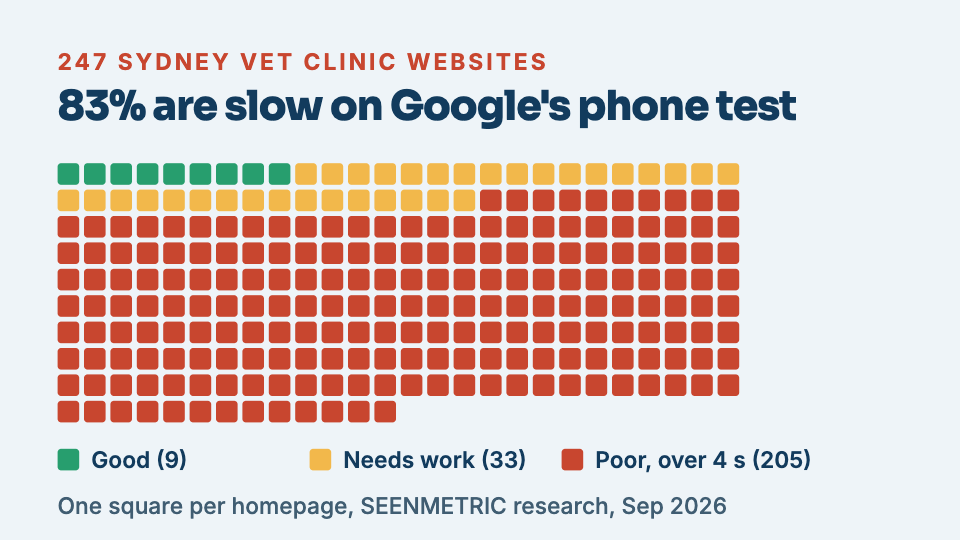
We checked 247 Sydney vet clinic websites. Most of them are slowly losing clients.
The clinics themselves are well reviewed. Their websites have not kept up, but most of the fixes are small.
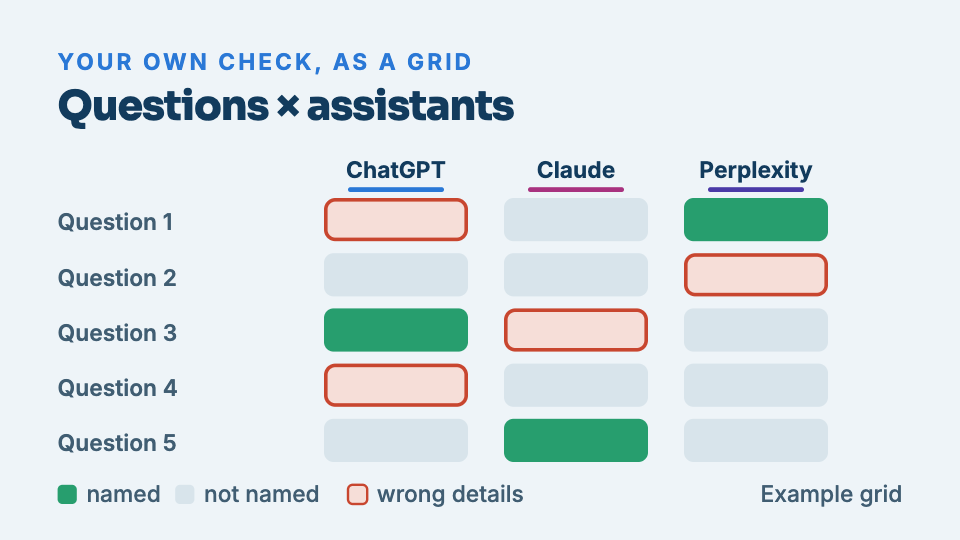
How do I check if ChatGPT recommends my business?
You do not need any tools or logins to find out what AI assistants say about your business. You need twenty minutes, the right questions, and a way to score the answers so one lucky result does not mislead you. Here is the whole method, step by step.