- Topic
- AI search, Comparisons
- Reading time
- 8 min
- Written by
- Dima SmetaninCo-founder, SEENMETRIC
- Published
- 26 September 2026
GuidesAI search
GEO vs AEO vs SEO: what actually changes
Three acronyms, sold sometimes as three separate retainers. Here is what SEO, AEO and GEO each actually optimise for, the foundation that is genuinely shared between them, and where the real split is worth paying attention to.
On this page
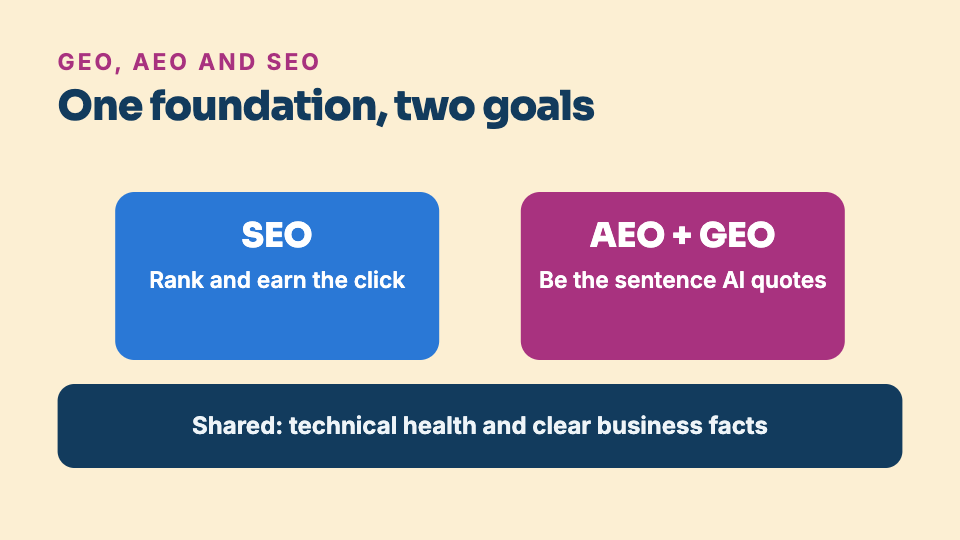
Three acronyms have shown up in the last two years for what is mostly one job: SEO, AEO and GEO. Some agencies sell them as three separate services, with three separate retainers. Before you pay for three of anything, it is worth knowing what actually changes between them, and what does not change at all.
The short version
- SEO, AEO and GEO are mostly one job. SEO asks whether Google will rank a page; AEO and GEO both ask whether an assistant will name or quote you, and they overlap heavily.
- Most of the work is shared. A fast, readable page that clearly says what you do, where and for how much helps on both sides, and none of it needs buying twice.
- The split is in what you aim for. Ranking work chases position and clicks; answer work needs a clean, quotable sentence that answers the exact question someone asked.
- Ranking on Google does not guarantee being named by an assistant. A large share of what assistants cite is not on Google's first page for the same question.
- Fix the shared foundation once, then choose your mix. Decide which outcome matters more from where your customers actually are.
Want to know where your business stands? Our Standard Audit reads up to 40 pages of your site, checks up to 300 Google searches you already show up for, sets you against up to three local competitors, and shows what ChatGPT says when customers ask up to 5 questions. A$149 one-off, delivered in two business days, no access to your site needed.
Get my Standard AuditWhat each one is actually asking
Strip away the marketing and each term is really just a different question about the same business.
- SEO, search engine optimisation, asks whether Google will rank a page. Success looks like a position in the list of ten blue links.
- AEO, answer engine optimisation, asks whether an assistant will read your page out as part of a direct answer, on Google's own AI answers or inside ChatGPT and Perplexity. Success looks like being named or quoted, not ranked.
- GEO, generative engine optimisation, is mostly the same question as AEO, asked with a slightly wider lens: how a business shows up across generative tools generally, including ones with no search box at all.
In practice, AEO and GEO overlap so heavily that treating them as two different jobs is mostly a naming exercise. The meaningful split is between SEO on one side, and AEO/GEO together on the other.
What is genuinely shared work
Most of what makes a page rankable also makes it citable. A fast, readable page that clearly states what a business does, where, and for how much helps Google rank it and helps an assistant quote it. Structured data that tells a machine what kind of business you are, and legitimate signals like reviews and consistent listings, work in both directions too. None of this needs to be bought twice, whatever the invoice calls it.
Where the work actually splits
The split shows up in what you optimise for, not in a different toolkit. Ranking work chases position and click-through: a compelling title, a meta description that earns the click, backlinks that build authority over months. Answer-visibility work chases a different outcome entirely: does the page contain a clean, quotable sentence that answers the exact question someone asked, and is the business named clearly enough that an assistant can lift it without guessing.
A page can do one and fail the other. A long, well-linked, well-ranked page that buries its actual answer three paragraphs down under throat-clearing gives an assistant nothing clean to quote. A short page with one precise answer near the top can get quoted by an assistant while never cracking page one of Google.
Assistants do not even agree with Google or each other
A large share of what an AI assistant cites in an answer is not on Google's own first page for the same question. The two systems draw on overlapping but genuinely different sources, so ranking well on Google is not a guarantee of being named by an assistant, and the reverse is just as true. Add in that ChatGPT, Perplexity and Google's own AI answers each lean on their own mix of sources, and "optimise for search" stops being one target. It is at least two, and they do not always move together.
Do not buy three retainers for one business. There is one job here with a lot of shared plumbing, and a genuine split in what the last mile of the work aims at.
What this means for how you spend
Fix the shared foundation once: it pays off on both sides regardless of what anyone calls it. Then decide, honestly, which outcome matters more to your business right now. A business getting most of its enquiries from Google's normal results still needs ranking work. A business that keeps losing the "who do you recommend" answer to a competitor needs the answer-focused work, whatever acronym is printed on the invoice. Most businesses need some of both, in a mix that should be argued from where your customers actually are, not from which service someone is trying to sell you.
If you are not sure which side of that split you are actually weak on, that is exactly what an AI visibility audit is for: it separates the two, tells you where the real gap is, and stops you paying for a fix you do not need. Our guide on how Australian businesses get found in AI search covers the answer-side work in full.
Keep reading
How Australian businesses get found in AI search
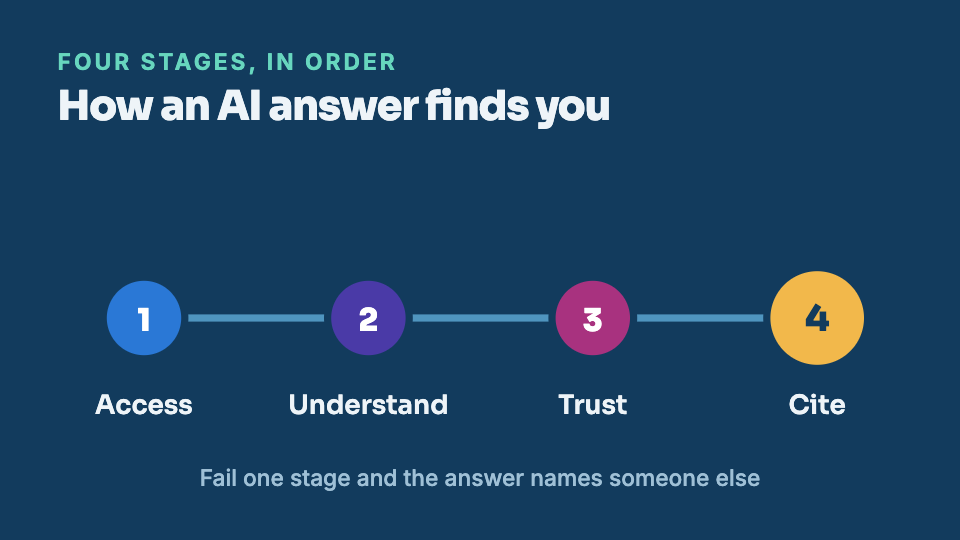
Search is splitting in two. Google still lists links, and a growing share of customers now get a single spoken answer from ChatGPT, Gemini or Perplexity instead. Here is what decides whether that answer names you.
What is an AI visibility audit?
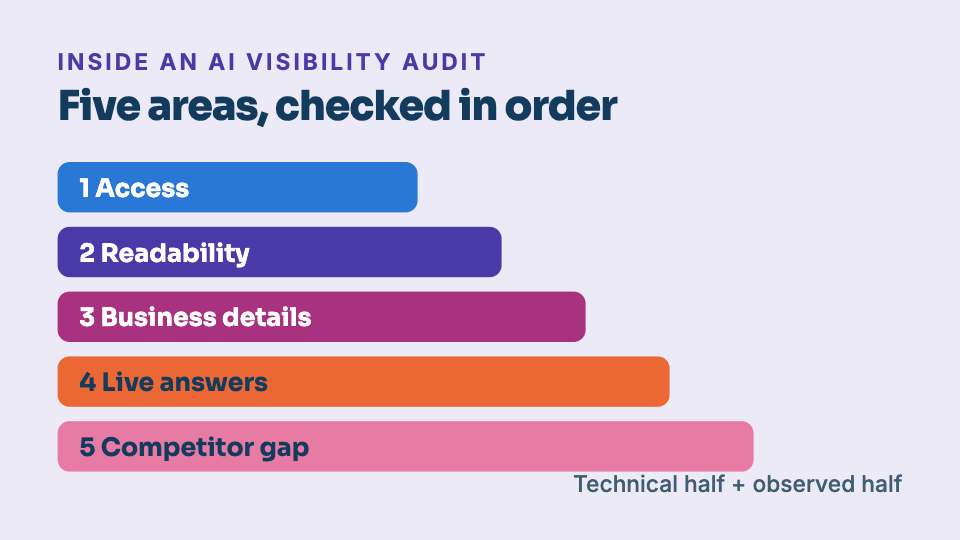
A regular SEO audit asks whether Google can rank you. An AI visibility audit asks a newer question: when a customer asks ChatGPT or Perplexity for a recommendation, are you in the answer? Here is exactly what one checks, and what it can and cannot promise.