- Topic
- AI search, Technical
- Reading time
- 11 min
- Written by
- Dima SmetaninCo-founder, SEENMETRIC
- Published
- 2 September 2026
GuidesAI search
How Australian businesses get found in AI search
Search is splitting in two. Google still lists links, and a growing share of customers now get a single spoken answer from ChatGPT, Gemini or Perplexity instead. Here is what decides whether that answer names you.
On this page
For a long time, getting found online meant one thing: showing up high on Google's list of blue links. That is still true, and it still matters in Australia. But a growing share of your customers now ask a question and get a single written or spoken answer back, from ChatGPT, Gemini or Perplexity, without ever seeing a list of websites. If your business is not in that answer, you are invisible to the person asking. This guide explains, in plain terms, how AI search actually works and what decides whether your business gets named.
The short version
- Search is splitting in two. Google still sends most of the traffic to most local businesses, but more customers now ask an assistant and get one answer naming two or three businesses.
- AI assistants read the same public web as Google. If Google can open, read and make sense of your pages, an AI assistant usually can too.
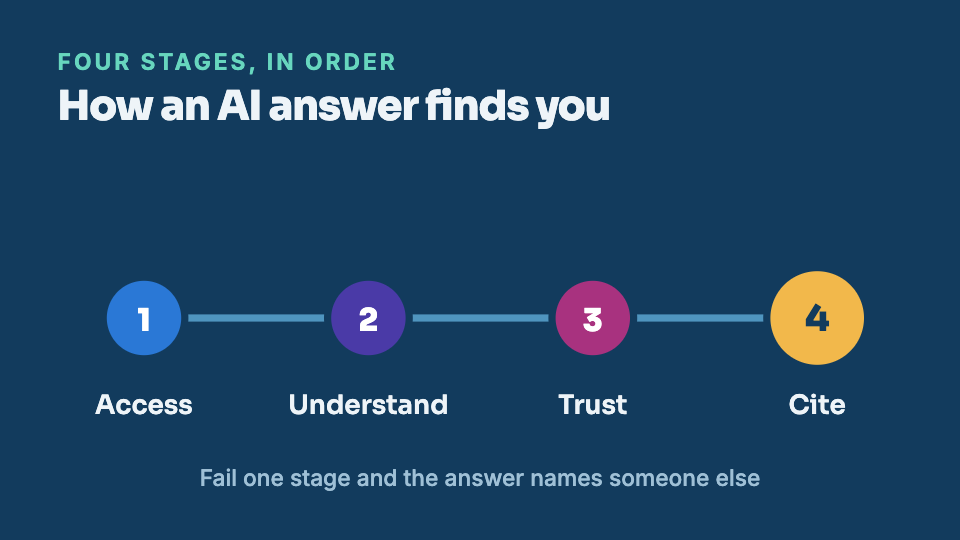
- Every AI answer moves through four stages. Access, understand, trust and cite; if a page cannot be opened, nothing written on it can be cited.
- The usual reasons for being missed are ordinary and fixable. A page that arrives almost empty to a machine, unclear business facts, or slow and clumsy loading.
- Work through the checklist in order. It makes a mention far more likely, but no one controls what an assistant says, so nothing guarantees one.
Want to know where your business stands? Our Standard Audit reads up to 40 pages of your site, checks up to 300 Google searches you already show up for, sets you against up to three local competitors, and shows what ChatGPT says when customers ask up to 5 questions. A$149 one-off, delivered in two business days, no access to your site needed.
Get my Standard AuditSearch is quietly splitting in two
Think about the two ways a customer might look for a business like yours today. The first is the one you know: they type into Google, get a page of ranked links, and pick one. The second is newer. They ask an assistant a plain question, “who does gutter cleaning near North Sydney?”, and get a short answer that names a few businesses and moves on. No list. No ten results to scroll. One reply.
Both of these are alive and well in Australia right now, and both will keep mattering for a while. Google still sends most of the traffic to most local businesses. But the assistant-style answer is growing, and it behaves differently. A ranked list gives you a chance to be chosen from ten options. An AI answer usually names two or three businesses and stops. Being in that short list is a different kind of visibility, and it is worth understanding on its own terms.
Where AI answers actually come from
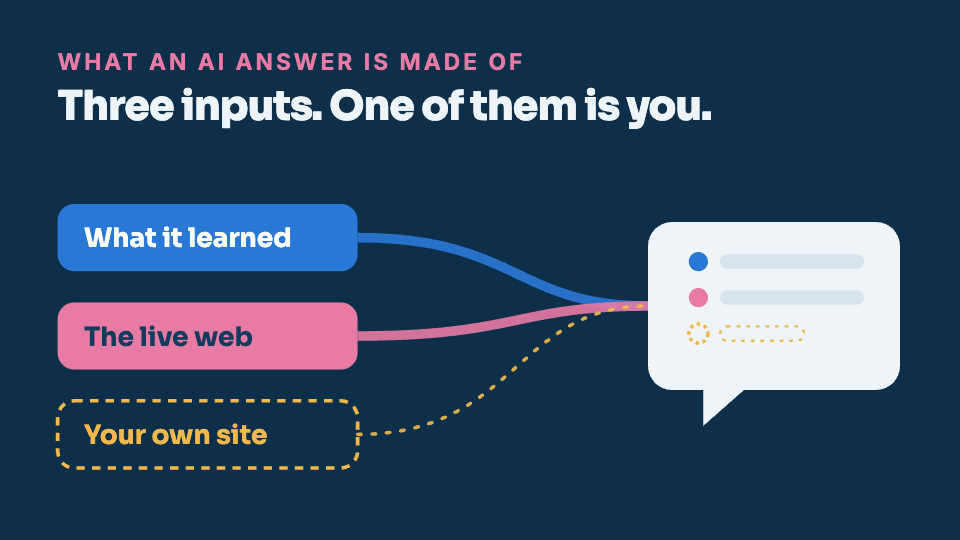
It is easy to imagine an AI assistant as a sealed box that already knows everything. In practice, when it answers a question about local businesses, it is reading the same public web that Google reads. It sends out a program that opens web pages, that is a crawler (an automated reader that fetches pages the way a browser does), takes what it finds, and stitches an answer together from the most useful pages.
That has a plain and useful consequence. If Google can open, read and make sense of your pages, an AI assistant usually can too. If Google struggles with your site, AI tools usually struggle in the same way. The two are not identical, but they lean on the same foundations, so fixing your site for one tends to help with the other. This is why the newer question of “does AI mention me?” often traces back to the older question of “can a machine actually read my website?”
The four things every AI answer needs from your site
When an AI assistant decides whether to name your business, it moves through four stages. Each one has to succeed before the next matters. If a page falls at the first hurdle, nothing after it can save you.
Access is the machine being able to open the page at all. If a crawler is blocked, or the page never finishes loading for anything but a human clicking around, the content behind it does not exist as far as AI is concerned. Understand is the assistant working out what you do and where you do it, from the words and the business facts on the page. Trust is whether those facts line up with what the rest of the web says about you, your listings, your reviews, mentions in the local press. Cite is the final step, where a page is clear and trustworthy enough that the assistant is willing to name you in its answer.
An AI answer works from the top of that rail down. If a page cannot be opened, nothing you wrote on it can be understood, trusted or cited.
Why some businesses are invisible to all of it
Most of the time, a business is missing from AI answers for one of a few ordinary reasons, and none of them are about writing cleverer marketing copy.
The first is a page that looks fine to you but arrives almost empty to a machine. Many modern sites build their content with JavaScript (code that runs in the visitor's browser to assemble the page after it loads). A person waits a moment and sees everything. A crawler can be handed a blank shell instead. We go through this in detail in how a site can load for people but not for Google, because it is one of the most common and least visible reasons a site never gets read.
The second is unclear or missing business facts. If a page never plainly states what you do, which suburbs you serve, and how to reach you, an assistant has nothing solid to lift. The third is speed and stability: a page that is slow or clumsy to load is harder for both people and machines to work with, which we explain without jargon in what Core Web Vitals actually measure. None of these are exotic problems. They are the quiet, fixable gaps that decide who gets read.
What you can actually do about it
You do not need to fix everything at once, and you do not need to be technical. Here is a short, ordered checklist, with the deeper guide for each item so you can go as far as you want.
- Make sure a machine can read your pages. Start with whether your content is really there when the page is fetched, covered in the guide on sites that load for people but not for Google.
- Get your speed and stability into decent shape, using the no-jargon guide to Core Web Vitals, so pages load quickly and hold still while they do.
- Tidy your local basics: a consistent business name, address and phone number everywhere they appear. The local checklist for Sydney businesses walks through why that quiet consistency decides the map pack.
- Understand what Google's own AI answer is doing above the results, and how to be the site it quotes, in the guide to AI Overviews in Australia.
- Learn what makes a page easy to lift a clean sentence from, so an assistant is willing to name it, in how to be the source an AI answer cites.
- If a competitor keeps getting named instead of you, work through why ChatGPT recommends them and not you to see what their answer is built from.
Working through these removes the barriers that keep you out of AI answers. None of it guarantees a mention, because no one controls what an assistant says. What it does is make it far more likely that when a customer asks, your business is one the machine can read, trust and name.
How to see where you stand
The quickest way to know whether any of this applies to you is to look at your own homepage the way a machine does. The Foundation Audit on seenmetric.com.au reads your homepage the way Google and AI assistants read it, looks at speed, the business details Google and AI read, and whether AI tools can get in at all, then emails you the issues worth fixing first. It asks for nothing but your web address, and it is a calm place to start before deciding what, if anything, is worth changing.
Keep reading
Why ChatGPT recommends your competitor, not you
Ask an AI assistant to recommend a plumber, a cafe or an accountant in your area, and it will name a handful of businesses. If yours is not one of them, that is not bad luck. Here is what the answer is actually built from.
Google AI Overviews have arrived in Australia. What now?
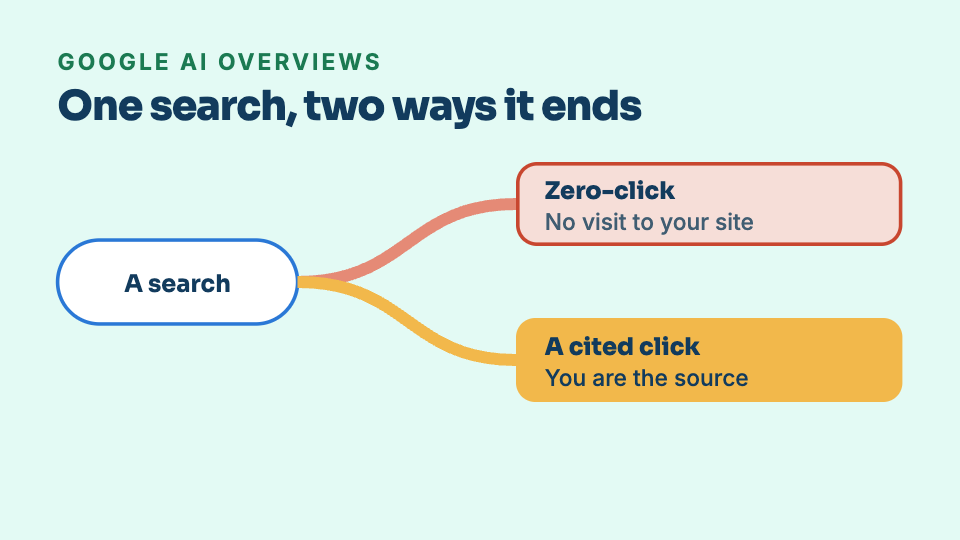
There is a new block at the top of many Google searches: an answer Google writes itself, before the usual list of links. It changes who gets the click, and being the source it quotes is now its own kind of visibility.