- Topic
- AI search
- Reading time
- 10 min
- Written by
- Dima SmetaninCo-founder, SEENMETRIC
- Published
- 11 September 2026
GuidesAI search
How to be the source an AI answer cites
AI assistants do not read the whole web on the spot. They pull a few passages, stitch them into an answer, and cite them. Getting cited is less about clever writing and more about being easy to lift a clean sentence from.
On this page
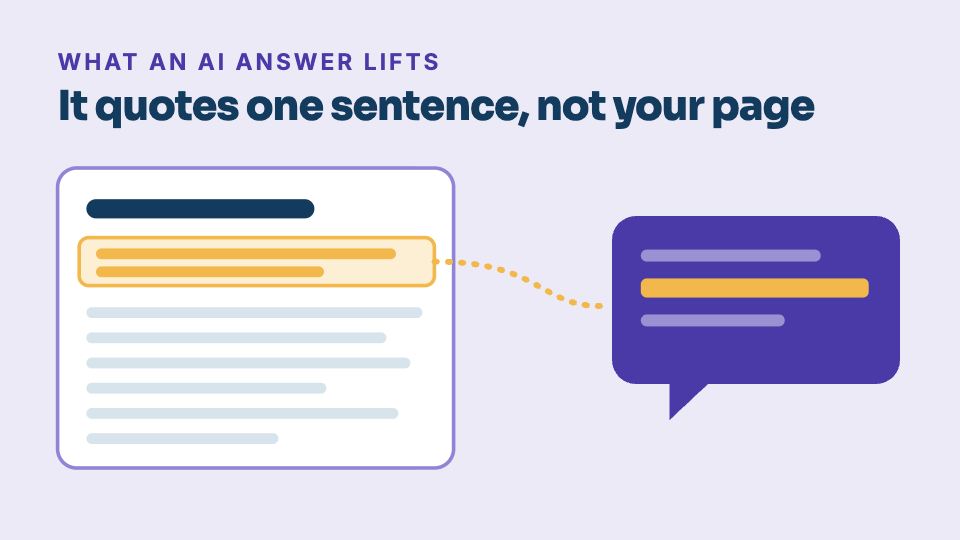
When Perplexity or ChatGPT answers a question, it does not recite your whole website. It grabs a few sentences from pages it already trusts, joins them into a short answer, and links the sources next to the words it borrowed. So the practical question is not “how do I write more”. It is “is there a clean sentence on my page that an assistant can lift without editing it”. This is a craft you can learn, and most of it is about structure rather than style.
The short version
- Assistants quote passages from pages they trust. Perplexity and ChatGPT lift a few sentences and link the source, so one strong paragraph can earn a mention.
- Write sentences that stand on their own. Put the answer right under the question, keep it plain and factual, and include specifics like place, price range and opening hours.
- Answer first, then explain. Use the customer's real question as a heading, keep paragraphs short, and use lists, simple tables and a genuine FAQ.
- Keep your facts the same everywhere. Matching name, address, phone and hours across your site, your Google listing and directories, plus mentions on other reputable sites, make an assistant more confident.
- Test it with a real customer question. Ask Perplexity or ChatGPT what a stranger would ask, read which pages get cited, and run it more than once.
Want to know where your business stands? Our Standard Audit reads up to 40 pages of your site, checks up to 300 Google searches you already show up for, sets you against up to three local competitors, and shows what ChatGPT says when customers ask up to 5 questions. A$149 one-off, delivered in two business days, no access to your site needed.
Get my Standard AuditHow an answer engine builds an answer
Picture what happens the moment someone asks an assistant a question. It does not open every page on your site and read it start to finish. It searches for a handful of pages that look relevant and trustworthy, pulls a short passage from each, and assembles those passages into a reply. The links you see beside the answer are its receipts: this line came from here, that line came from there.
Two things follow from that. First, the unit that gets cited is a passage, not a page, so a single strong paragraph can earn you a mention even on an otherwise ordinary page. Second, the assistant is working fast and lifting text more or less as written. If your best answer is tangled up with three other ideas in one long sentence, it is harder to lift cleanly, and a clearer sentence somewhere else wins the spot.
What makes a passage easy to lift
Some sentences travel well and some fall apart the moment they leave the page. The difference is whether the sentence still makes sense to a stranger who cannot see anything around it. An assistant pulling a passage has exactly that stranger's view, so the sentences that get picked share a few plain qualities.
- The answer sits right under the question. If the heading asks “how much does a service cost”, the very next line should say roughly what it costs. An assistant reading top to bottom finds the answer where it expects it.
- The sentence stands on its own. “We do that too” means nothing lifted out of context. “We repair ducted heating in the inner west, usually within two days” carries its meaning wherever it lands.
- The claim is plain and factual. Concrete statements are easy to quote and easy to trust. A sentence built from adjectives and promises gives an assistant nothing solid to repeat.
- The specifics are actually there. Place, price range, opening hours, who the service is for. These are the details a customer question hinges on, and the details an assistant reaches for.
None of this asks you to write badly or robotically. It asks you to make sure the answer a customer wants is stated once, in full, in a single sentence, rather than assembled in the reader's head from three paragraphs.
Structure beats clever writing
The biggest gains here come from layout, not language. A page that is organised the way a question is answered gives an assistant an easy passage to take. A page that saves its best information for the bottom makes the machine work for it, and often the machine gives up and quotes someone else.
- Use the real question as a heading. Write the words a customer would type or say, then answer them. A heading that matches the question helps the assistant match your page to it.
- Answer in the first sentence, then explain. Give the direct answer immediately, and put the caveats, examples and detail underneath. This is the single most useful habit on the list.
- Keep paragraphs short. A two or three sentence paragraph is easier to lift a clean line from than a dense block where every idea leans on the one before it.
- Use lists and simple tables for comparisons. When you are laying out options, prices or differences, a small table states each fact in its own cell, which is exactly the shape an assistant can read without guessing.
- Write a genuine FAQ. Real questions with real one-line answers are close to the ideal format, because each entry is already a question followed immediately by its answer.
The trust layer
Being easy to quote gets you halfway. The other half is being worth quoting. An assistant is trying not to repeat something wrong, so it leans towards pages whose facts hold together and line up with what it finds elsewhere. You build that trust quietly, over time, and it is less about tricks than about not contradicting yourself.
- Keep your facts consistent across the web. Same business name, address, phone and hours on your site, your Google listing and any directory that mentions you. When the same detail appears the same way in several places, an assistant repeats it with more confidence. The groundwork for that is in our guide on keeping your business facts consistent.
- Make the author or business identity clear. A page that plainly says who is behind it, and shows real experience, reads as more accountable than an anonymous block of text.
- Earn mentions from other reputable sites. A write-up in the local press, a supplier page, an industry body listing. Being talked about elsewhere gives the assistant more than one source agreeing on the same thing.
- Do not contradict yourself page to page. If one page says you serve the whole city and another names three suburbs, you have handed the assistant a reason to doubt both. Pick the true version and use it everywhere.
An assistant is not looking for the cleverest page. It is looking for the page it can quote without being caught out later, which means clear, consistent and backed up elsewhere.
If your site arrives blank to software, none of this trust work can help, because there is nothing for the assistant to read. That failure is more common than owners expect, and it is worth ruling out first: our guide on why an assistant names your competitor walks through how a business goes missing in the first place.
Test it yourself
You do not need a tool to see whether this is working. You need the question your customer would ask and a few minutes. Open Perplexity or ChatGPT and ask it the plain thing a stranger would ask, using the words they would use, not your own marketing phrasing.
- Ask a real customer question. The need, not your business name. Something like the service plus your suburb, or “who does this near me”.
- Read which pages get cited. Look at the links beside the answer. Those are the passages the assistant trusted enough to borrow. Notice whose page they came from.
- See whether a competitor is quoted where you should be. If a rival's page is being lifted for a question you answer better, open their page and find the sentence that got taken. It is usually a plain, self-contained answer sitting right under a clear heading.
Run it more than once, and try more than one assistant, because their answers vary between attempts and drift over weeks. The same craft applies to Google's AI answers at the top of a search, which we cover in our guide to Google AI Overviews in Australia, and it sits inside the wider picture laid out in our overview of getting found in AI search.
If you would rather start by fixing the barriers, our Foundation Audit reads your homepage the way software does and flags whether your pages arrive readable at all, along with the business details Google and AI read. And if you want to see exactly which pages the assistants quote for your customers' questions, our Advanced Audit asks ChatGPT, Gemini, Claude and Perplexity the questions a potential customer might ask, quotes the answers in full, and shows you where a clearer sentence would improve the odds of being cited.
Keep reading
Why ChatGPT recommends your competitor, not you
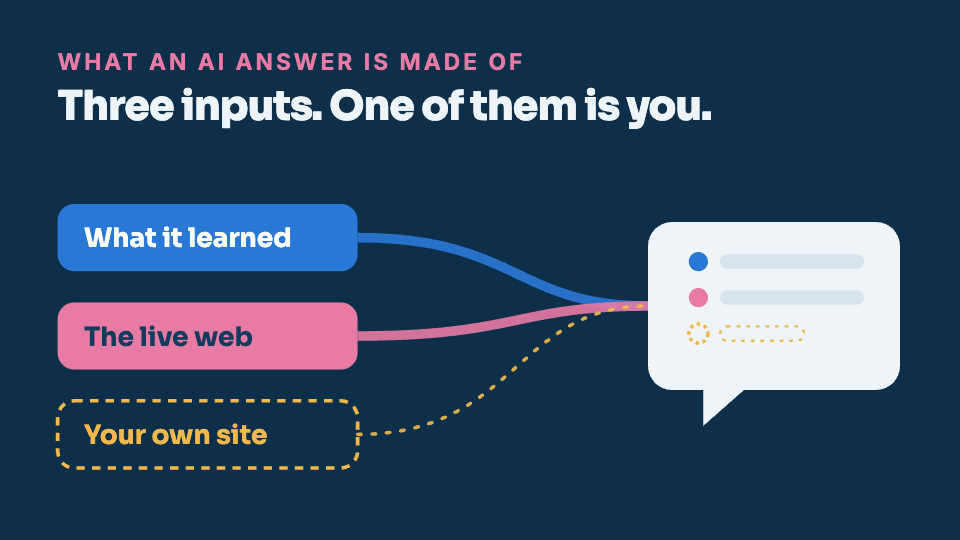
Ask an AI assistant to recommend a plumber, a cafe or an accountant in your area, and it will name a handful of businesses. If yours is not one of them, that is not bad luck. Here is what the answer is actually built from.
How Australian businesses get found in AI search
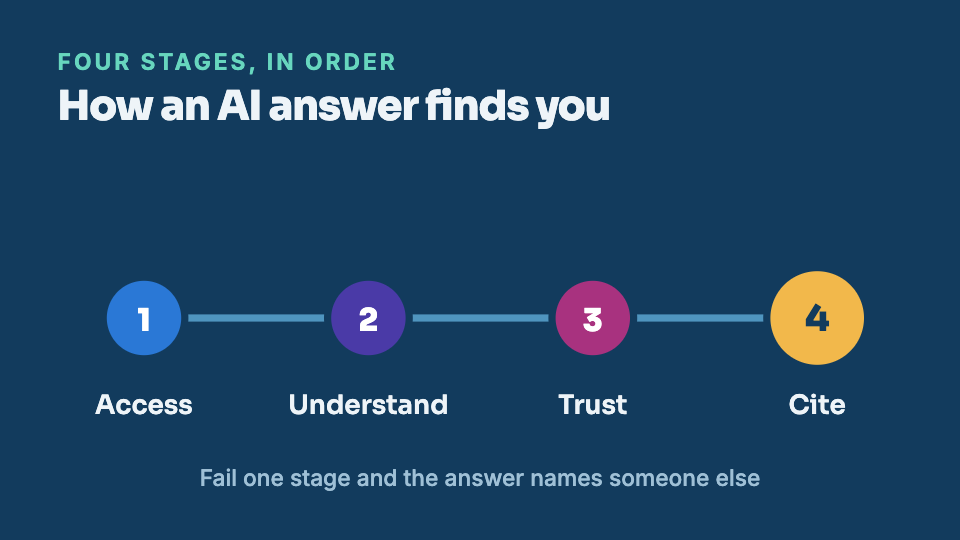
Search is splitting in two. Google still lists links, and a growing share of customers now get a single spoken answer from ChatGPT, Gemini or Perplexity instead. Here is what decides whether that answer names you.