- Topic
- AI search
- Reading time
- 10 min
- Written by
- Dima SmetaninCo-founder, SEENMETRIC
- Published
- 4 September 2026
GuidesAI search
Why ChatGPT recommends your competitor, not you
Ask an AI assistant to recommend a plumber, a cafe or an accountant in your area, and it will name a handful of businesses. If yours is not one of them, that is not bad luck. Here is what the answer is actually built from.
On this page
You typed your own trade and suburb into ChatGPT, asked it to recommend someone, and watched it name two or three businesses that were not you. It is an unpleasant moment, and a common one. The good news is that the answer is not a verdict on your work. It is the result of a fairly mechanical process, and once you can see the parts, you can see where you have gone missing.
The short version
- Test it the way a customer would. Ask ChatGPT, Claude or Perplexity for the service you offer where you work, in a stranger's words, and note who gets named.
- The answer is built from three ingredients. What the model learned in training, what it can read on the live web now, and how clearly your own site says who you are and what you do.
- Named competitors have usually done a few plain things well. The same facts everywhere, an obvious trade and location, a site software can read, mentions elsewhere, and reviews with a complete Google Business Profile.
- Ranking on Google and being named by AI are different tests. You can sit on page one of Google and still be absent from the AI answer.
- One check is not a measurement. Try several phrasings, more than one assistant and more than one day, and look for the pattern.
Want to know where your business stands? Our Standard Audit reads up to 40 pages of your site, checks up to 300 Google searches you already show up for, sets you against up to three local competitors, and shows what ChatGPT says when customers ask up to 5 questions. A$149 one-off, delivered in two business days, no access to your site needed.
Get my Standard AuditTry it yourself right now
Before you read any further, run the test properly. Open ChatGPT (or Claude, or Perplexity) and ask the plain question a customer would ask. Not your business name. The need. Something like “recommend a plumber in Marrickville”, or “who are the good bookkeepers near Geelong”, or “best physio for a running injury in Fremantle”. Use the words a stranger would use, not the ones you would use.
Then read the answer slowly and note two things: which businesses get named, and how confidently the assistant describes each one. You are not looking for your ranking. You are looking for whether you appear at all, and if you do not, who is standing in the spot you expected.
If you would rather see one first, our industry pages quote a real, dated ChatGPT answer for 21 Australian trades, from plumbers to physios, word for word.
What the AI answer is actually built from
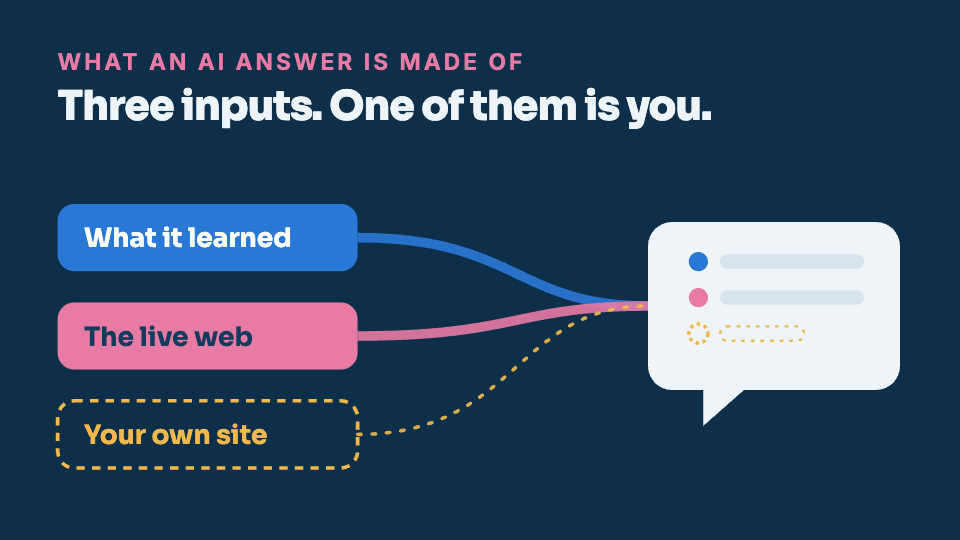
An assistant does not keep a ranked list of Australian businesses in a drawer. When you ask for a recommendation, it assembles a fresh answer out of three ingredients, and your visibility depends on all three.
- What it learned during training. The model has read an enormous slice of the web, but frozen at a point in the past. If your business was well described across that older web, some memory of you may already be in there. If it was thin or new, there is nothing to remember.
- What it can read on the live web right now. Most assistants can also look things up as they answer, pulling in current pages. This is where a business that was invisible last year can start to appear, if the live pages about it are clear and readable.
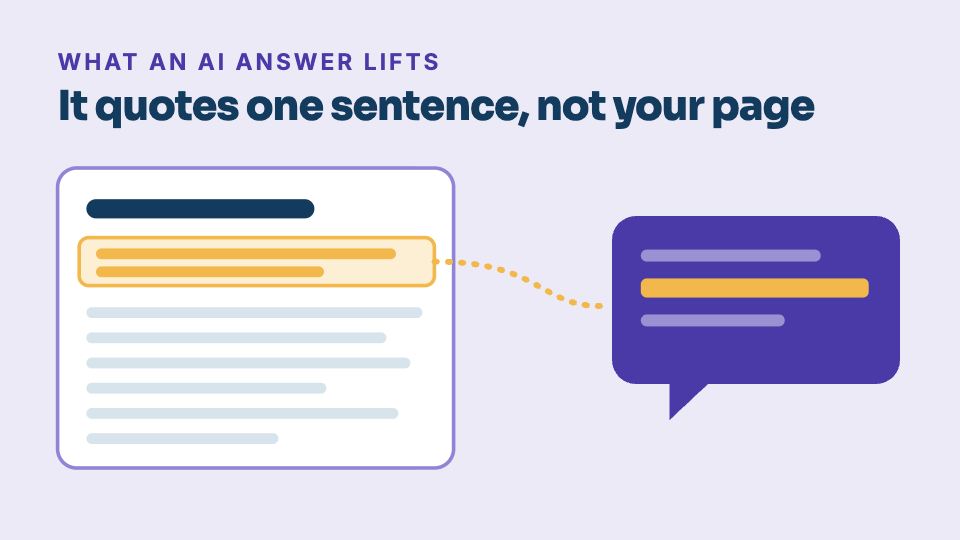
- How clearly your own site states who you are and what you do. When the assistant lands on your page, it needs to lift a plain fact: this is a plumber, in this suburb, doing this work. If your site only implies that through a hero image and a slogan, the assistant leaves with nothing solid to quote.
Reasons your competitor gets named and you do not
When a competitor keeps showing up in place of you, it is rarely because they paid for it. Usually they have quietly done a few unglamorous things well.
- They are described the same way everywhere. Same business name, same address, same phone, same category, across their site, their Google listing and the directories that mention them. That consistency is what lets an assistant say their name with confidence. Getting those facts to match is the subject of our guide on keeping your business facts consistent.
- Their category and location are unmistakable. A stranger reading their homepage for five seconds could tell you what they do and where. So can a machine.
- Their site is actually readable by software. If a page only fills in its text after the browser runs a pile of code, an assistant can arrive to find it blank. That failure mode is common and invisible, and we cover it in when your site loads for people but not for machines.
- Other people mention them. A write-up in the local paper, a supplier page, a community listing. Being talked about elsewhere gives the assistant more than one source to trust.
- They have reviews and a complete Google Business Profile. Filled-out hours, categories, service area and a steady trickle of reviews all feed the picture.
None of that is a growth hack. It is being described clearly and consistently in enough places that a machine can repeat it without guessing.
Being mentioned is a different problem from ranking
It is tempting to assume that if you rank well on Google, AI assistants must know you too. They are related, but they are not the same test, and the gap surprises people.
You can sit on page one of Google and still be absent from the AI answer, and you can be named by an assistant while ranking nowhere near the top. They are scored on different things.
Ranking rewards a page that matches a search and earns clicks. An AI mention rewards a business that can be described in a clean sentence and backed by more than one source. A page can be a strong search result and still be hard to quote, because being quotable is its own quality. That quality is what our guide on being the source an AI answer cites is about, and it is worth reading alongside this one.
How to check properly
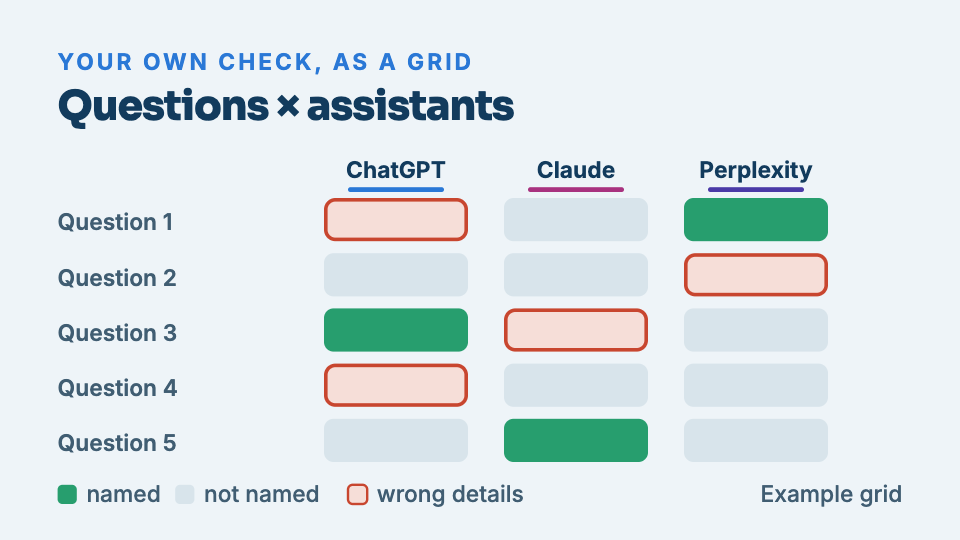
One test is not a measurement. Assistants vary their wording between runs, and their answers shift over weeks as the live web and the models change. Treat your check the way you would treat asking three different locals for a recommendation.
- Ask several phrasings. “Best”, “affordable”, “emergency”, “near me”, the service plus the suburb, the service plus the city. Different phrasings pull different answers.
- Try more than one assistant. ChatGPT, Claude and Perplexity draw on different sources and will not agree. Being named by one and missed by another is normal and useful to know.
- Run it more than once. Ask the same thing tomorrow. If you appear sometimes and not others, that is a real signal about how shaky your presence is.
Do not read a single result as final, in either direction. One flattering answer is not proof you are safe, and one that leaves you out is not proof you are doomed. You are looking for the pattern across a handful of tries. If you want the wider picture of how these answers get built and who tends to win them, start with our overview of getting found in AI search.
Where to start
The first thing worth ruling out is the dullest one: whether AI tools can read your site at all. If your pages arrive blank to software, no amount of good work will get you named, because there is nothing to read. Our Foundation Audit flags exactly that, along with the business details Google and AI read and how your homepage looks to a machine. It asks for a URL and nothing else, and it improves the odds by removing the barriers before you spend a cent.
If you want to know what the assistants actually say about you, rather than guess, our Advanced Audit asks ChatGPT, Gemini, Claude and Perplexity the questions a potential customer might ask, quotes the answers in full, and shows you who gets named in your place. It will not promise a mention, because nobody honestly can. What it does is tell you precisely where you stand today and which barriers to remove first.
Keep reading
How do I check if ChatGPT recommends my business?
You do not need any tools or logins to find out what AI assistants say about your business. You need twenty minutes, the right questions, and a way to score the answers so one lucky result does not mislead you. Here is the whole method, step by step.
How to be the source an AI answer cites
AI assistants do not read the whole web on the spot. They pull a few passages, stitch them into an answer, and cite them. Getting cited is less about clever writing and more about being easy to lift a clean sentence from.