- Topic
- AI search
- Reading time
- 10 min
- Written by
- Dima SmetaninCo-founder, SEENMETRIC
- Published
- 9 September 2026
GuidesAI search
Google AI Overviews have arrived in Australia. What now?
There is a new block at the top of many Google searches: an answer Google writes itself, before the usual list of links. It changes who gets the click, and being the source it quotes is now its own kind of visibility.
On this page
If you have searched Google lately and noticed a written answer at the very top of the page, before any of the usual links, you have met an AI Overview. Google now reads a handful of web pages, writes a short summary of the answer itself, and puts it above everything else. It is a real change to how the results page works, and it changes who gets the click. This guide explains what an AI Overview is, that it now shows up on Australian searches, what it does to your traffic, which searches set it off, and how to be one of the sources it draws from. The tone here is calm on purpose. This is a shift in how answers are shown, not an emergency.
The short version
- An AI Overview is Google's own written answer at the top. Google reads a few pages, summarises them above the usual links, and lists the sources it drew from.
- It now shows on Australian searches, but not on every one. Which searches trigger it, the wording and the sources picked can change from day to day and person to person.
- Fewer clicks, but the ones you get are further along. Simple questions may get answered with no visit, while people with bigger questions click a cited source to get the detail.
- Question pages are affected most. Overviews lean towards how-tos, comparisons and definitions, so review your guides and FAQs before your service pages.
- Make your page easy to quote. Answer early, use headings that match how people ask, keep the page readable by machines and state correct business facts; no one can promise a spot.
Want to know where your business stands? Our Standard Audit reads up to 40 pages of your site, checks up to 300 Google searches you already show up for, sets you against up to three local competitors, and shows what ChatGPT says when customers ask up to 5 questions. A$149 one-off, delivered in two business days, no access to your site needed.
Get my Standard AuditWhat an AI Overview actually is
An AI Overview is a short answer that Google writes and places at the top of the results, above the familiar list of blue links. Instead of only ranking pages and leaving you to read them, Google reads a few of those pages for you, summarises what they say, and shows that summary first. Next to the summary it lists a small set of source links, the pages it drew the answer from, so a reader can go and check the detail if they want to.
The important part is the position. The AI Overview sits above the normal results, so it is the first thing a searcher sees, and the ordinary ten links are pushed further down the page. The answer is built from real web pages, and the sources it cites are named right there beside it. So being one of those cited sources is now its own kind of visibility, separate from ranking first in the list below.
It has reached Australian searches
This is not only an overseas experiment. AI Overviews have been rolling out to Australian searches, and Google has talked about them openly as part of its wider work on AI in Search, including AI Mode and the features it tests through Search Labs. If you search from Australia today, there is a fair chance you have already seen one, even if you did not know what it was called.
A few things are worth keeping in mind. It does not appear on every search, and which searches trigger it keeps changing as Google adjusts the feature. The exact wording of an answer, the sources it picks, and even whether an Overview shows at all can differ from one day to the next and from one person to another. So it is normal to see an Overview on a question one week and a plain list of links the next. Treat it as a moving feature rather than a fixed new layout.
What it does to your clicks
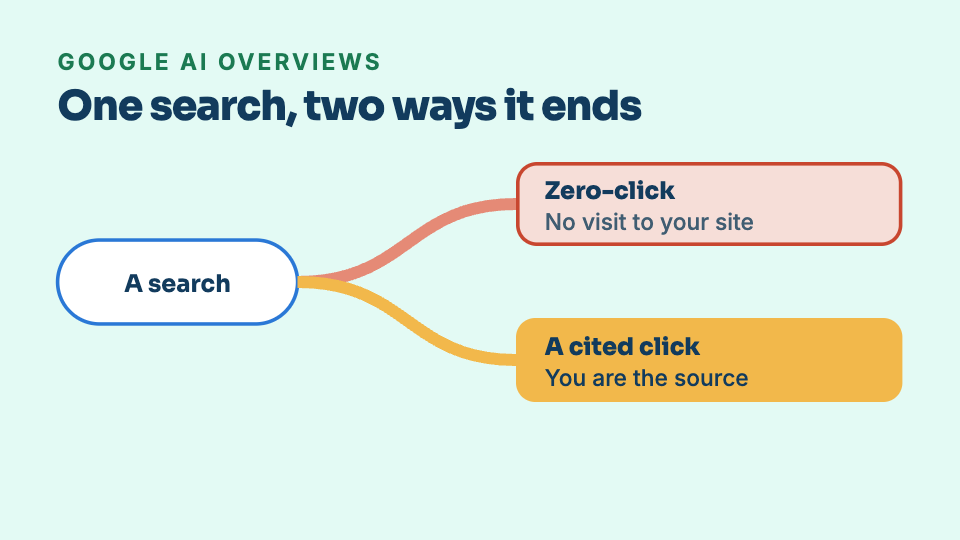
An AI Overview changes what happens after the search in two different ways, and it helps to hold both in mind at once rather than only the gloomy one.
Some questions now get answered on the results page itself. If someone asks what time a public holiday falls on, or how to get a wine stain out of a carpet, they may read the Overview, feel satisfied, and never click through to a website. That is a zero-click search, where the answer was enough and no visit followed. For simple, factual questions, this share is real and it is not going away.
The other outcome matters just as much. When a question needs more than a sentence, a price, a comparison, a decision the reader is nervous about, people do click a cited source to get the detail. Those visitors arrive having already read a summary and chosen to dig deeper, so they tend to be better qualified than someone idly scanning a list. Fewer raw clicks, but the ones you get are further along. Being the source they click is the outcome to aim for.
Which searches trigger one
AI Overviews lean towards questions, not brand names or ready-to-buy searches. You are far more likely to see one on an informational search, a how-to, a comparison, or a plain definition, than on someone typing your business name or heading straight to checkout. Someone searching “how often should a heat pump be serviced” or “what is the difference between a conveyancer and a solicitor” is exactly the kind of query that tends to get an Overview. Someone searching your business name, or “book plumber Geelong”, usually is not.
For most businesses that points to a clear place to look. Your service and product pages, the ones a ready buyer lands on, are less affected. The pages that answer questions, your guides, your FAQs, the “how it works” and “what to expect” explanations, are the ones most likely to be read for an Overview. Those are the pages worth reviewing first, because they are where being quoted is both possible and useful.
How to be a source it draws from
You cannot control what Google writes, and no one can promise you a spot in an Overview. What you can do is make your pages easy to read and easy to quote, which improves the odds of being one of the sources it draws from. The habits that help here are plain and they overlap almost entirely with just writing a clear, honest page.
- Answer the actual question clearly and early. If a page is about a question, give the direct answer near the top in a sentence or two, then expand below. A page that makes a reader hunt for the answer makes a machine hunt too.
- Use headings that match how people ask. If customers say “how much does it cost”, a heading that says exactly that is easier to match than a clever one. Write the way your customers speak.
- Keep the page readable by machines. If your content is assembled by code that only runs for a human clicking around, a crawler can be handed a near-empty page. We cover this in why an assistant recommends a competitor and not you, which is the same problem seen from the AI assistant side.
- Have clear, correct business facts. What you do, where you do it, your hours and how to reach you, stated plainly and matching what the rest of the web says about you. Being easy to quote is mostly about being easy to lift a clean, correct sentence from.
If you want the fuller picture, our overview of how Australian businesses get found in AI search ties these habits together, and how to be the source an AI answer cites goes deeper on what makes a single passage quotable. The quickest way to see where your own homepage stands is the Foundation Audit on seenmetric.com.au, which reads your page the way a machine does and emails you what to fix first.
You cannot make Google quote you. You can make your page the clearest, most correct answer to the question, which is what makes you easy to quote.
What not to panic about
It is easy to read all this as the sky falling, so it is worth saying plainly that it is not. An AI Overview is a change in how answers are shown, not a change in what earns them. The site that wins is still the readable, trustworthy one that answers the question well. The work you would do to rank properly and to be understood by an AI assistant is the same work that makes you a good Overview source. Nothing you have built is wasted.
The one thing worth resisting is the urge to chase tricks. There is no secret phrase that forces Google to quote you, and anything that promises one is selling a shortcut that tends to age badly. The feature will keep changing, and the sites that hold up through those changes are the ones that were clear, correct and genuinely useful in the first place. If you want a full picture of where your site sits across all of this, our Standard Audit (A$149) checks your whole site, measures real page speed, asks AI tools the questions a potential customer might ask, and ranks every finding by what it is costing you. Whether you start there or with the Foundation Audit, the direction is the same. Be the clearest answer, and let the machines do the quoting.
Keep reading
How Australian businesses get found in AI search
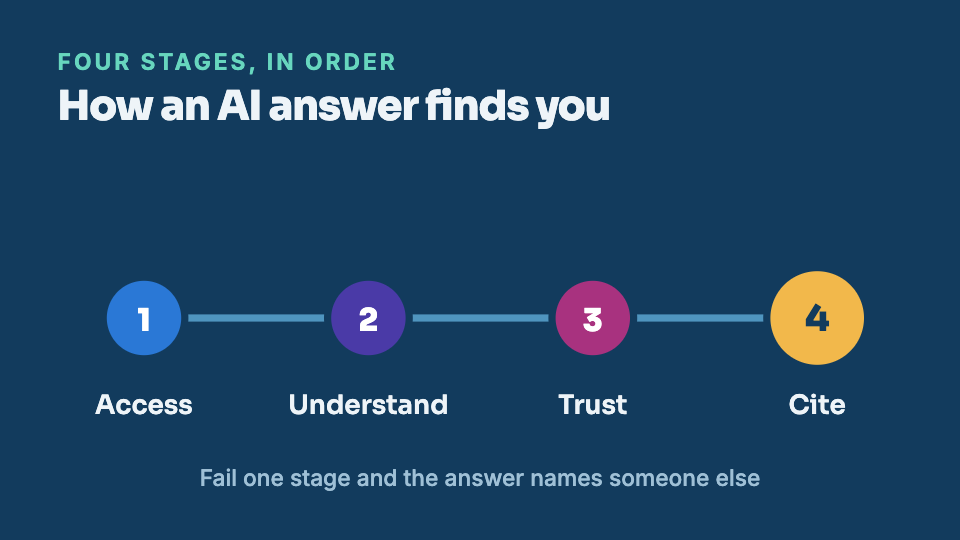
Search is splitting in two. Google still lists links, and a growing share of customers now get a single spoken answer from ChatGPT, Gemini or Perplexity instead. Here is what decides whether that answer names you.
Why ChatGPT recommends your competitor, not you
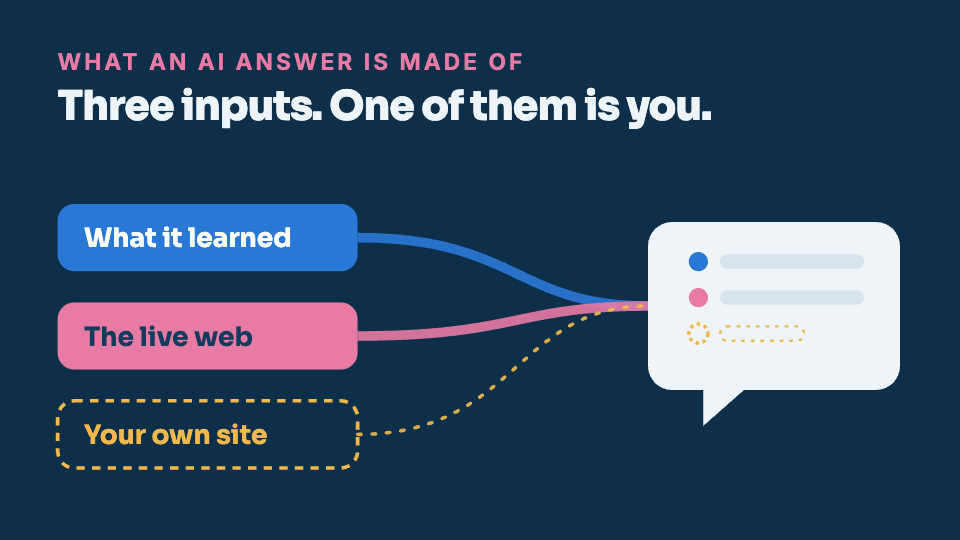
Ask an AI assistant to recommend a plumber, a cafe or an accountant in your area, and it will name a handful of businesses. If yours is not one of them, that is not bad luck. Here is what the answer is actually built from.