- Topic
- AI search
- Reading time
- 9 min
- Written by
- Dima SmetaninCo-founder, SEENMETRIC
- Published
- 14 September 2026
GuidesAI search
What is an AI visibility audit?
A regular SEO audit asks whether Google can rank you. An AI visibility audit asks a newer question: when a customer asks ChatGPT or Perplexity for a recommendation, are you in the answer? Here is exactly what one checks, and what it can and cannot promise.
On this page
For twenty years, being found online meant one thing: ranking on Google. Now a growing share of your customers skip the list of links entirely and ask ChatGPT, Gemini or Perplexity a question, and the assistant answers with two or three business names. An AI visibility audit exists to answer one question about that new reality: when the assistant speaks, are you in the answer, and if not, what is keeping you out?
The short version
- An AI visibility audit checks how AI assistants see and describe your business. One half checks whether AI tools can reach and read your site; the other puts real customer questions to the assistants and records the answers.
- It grades something different from an SEO audit. An SEO audit asks whether a page can rank; this one asks whether a business can be described, so you can be on page one of Google and still not appear in an AI answer.
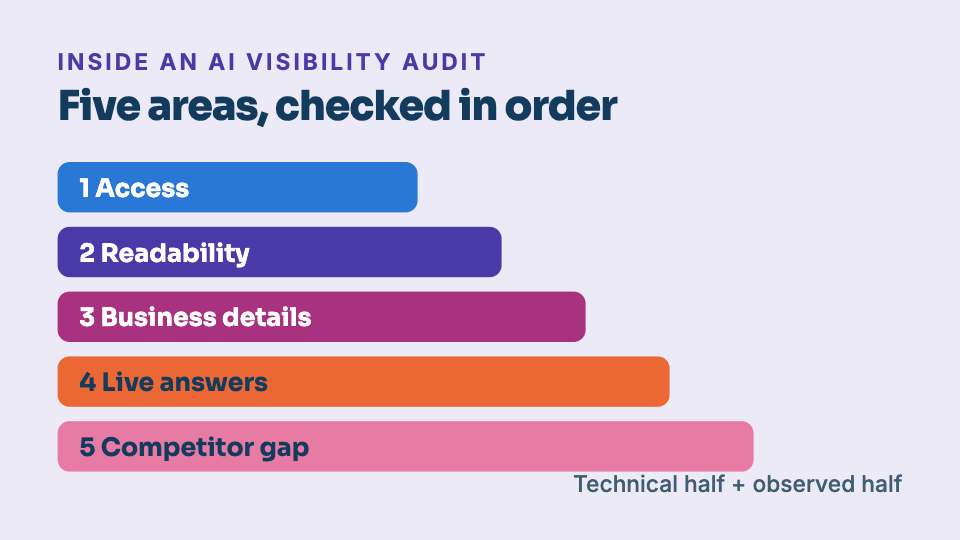
- A thorough audit covers five areas. Access, readability, the business details Google and AI read, live answer testing, and the gap between you and the competitors being named.
- Nobody can guarantee a mention. An honest audit finds the barriers that make a mention unlikely and gives you the fixes in the order they are worth doing.
- Check it yourself first. Asking the assistants takes a spare twenty minutes; then the Foundation Audit flags access and readability barriers, and a full audit explains why competitors get named.
Want to know where your business stands? Our Standard Audit reads up to 40 pages of your site, checks up to 300 Google searches you already show up for, sets you against up to three local competitors, and shows what ChatGPT says when customers ask up to 5 questions. A$149 one-off, delivered in two business days, no access to your site needed.
Get my Standard AuditThe short definition
An AI visibility audit is a structured check of how AI assistants see and describe your business. It has two halves. The first half is technical: can AI tools reach your website, read what is on it, and lift the plain facts about who you are, what you do and where you do it. The second half is observational: someone puts real customer questions to the assistants, records the answers word for word, and reports who gets named, how you are described, and which competitors keep taking the spot you expected.
The output is not a score for bragging rights. It is a list of specific barriers, ranked by how much each one is likely costing you, each with a fix.
How it differs from a regular SEO audit
The two overlap, because assistants lean on the same web Google reads. But they grade different things, and a site can pass one test while failing the other.
- An SEO audit asks whether a page can rank. It looks at keywords, links, indexing, speed, and how your pages compare with the ones above them in the results.
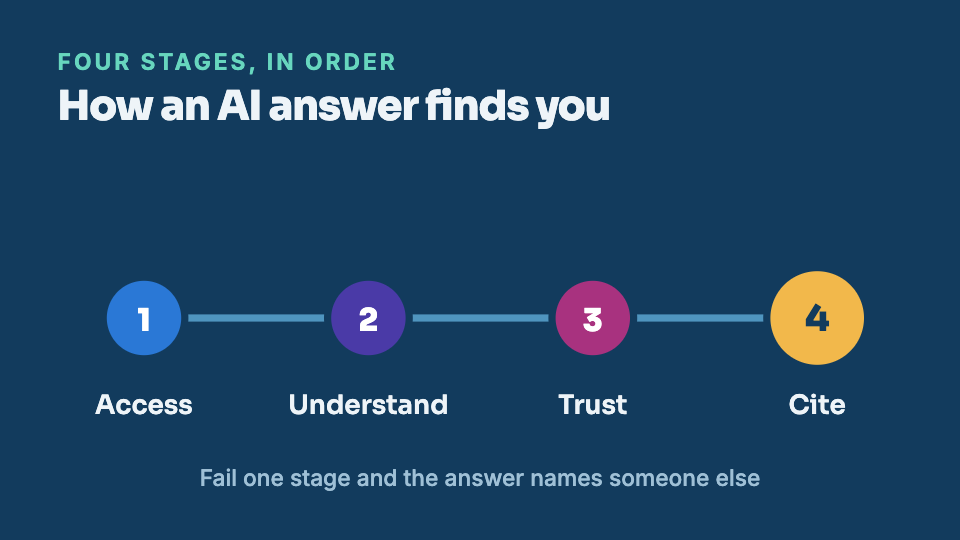
- An AI visibility audit asks whether a business can be described. Assistants answer in sentences, so what matters is whether a machine can state, with confidence, what you do, where you are, and why you are worth naming. That depends on readable pages, consistent business facts across the web, and other sources that mention you.
This is why a business can sit on page one of Google and still never appear in an AI answer. If you have seen that happen to you, our guide on why ChatGPT recommends your competitor walks through the mechanics behind it.
What a real audit actually checks
Names for this vary: GEO, AEO, AI SEO. Under any label, a thorough audit covers five areas.
- Access. Whether AI crawlers and browsing tools can get into your site at all. Some sites block them without knowing it, through a firewall setting, a bot rule, or a robots.txt line someone copied years ago.
- Readability. Whether your pages arrive as text a machine can use, or as an empty shell that only fills in after a browser runs code. A page like that reads as blank to many tools; our guide on sites that load for people but not for machines covers this failure in detail.
- The business details Google and AI read. Whether your name, address, services, hours and prices are stated as structured data machines can lift, and whether they match what Google, directories and review sites say about you. Disagreement between sources makes an assistant hedge, and a hedging assistant names someone else.
- Live answer testing. The part you cannot see from your own website: real customer questions put to ChatGPT, Claude, Perplexity and Google's AI results, with the answers quoted word for word. This is the ground truth the rest of the audit explains.
- The competitor gap. For every question where a competitor is named and you are not, what they have that you lack: consistent listings, readable pages, reviews, mentions in places assistants trust.
What it cannot promise
Nobody can guarantee that ChatGPT will recommend you. Anyone who promises a specific AI mention is selling something the assistants themselves do not offer.
Assistants change their answers between runs, between models and between months. What an audit can honestly do is find the barriers that make a mention unlikely or impossible, show you where you stand today, and leave you with fixes in the order they are worth doing. Once the barriers are gone, you are competing on the same footing as the businesses currently being named.
Can you do it yourself?
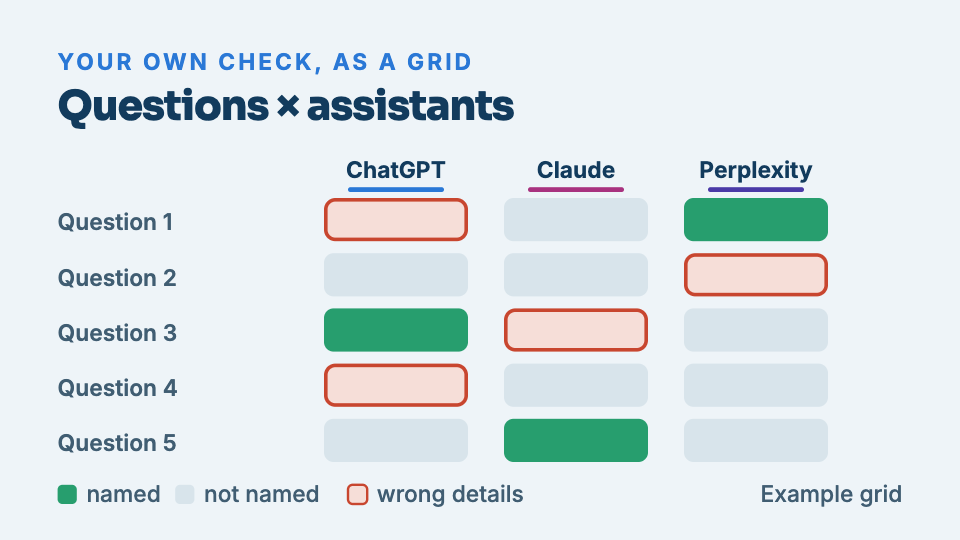
Part of it, yes, and you should. The live-answer half needs nothing but the assistants themselves and a spare twenty minutes; we wrote a step-by-step method in how to check if ChatGPT recommends your business. The technical half is harder to do by hand, because the failures are invisible from a normal browser: you cannot see your own site the way Google does, and the business details it reads do not appear on the screen.
A sensible order: run the self-check first, so you know whether you have a problem. Then run our Foundation Audit, which reads your homepage the way machines do and flags the access and readability barriers. If the self-check shows competitors being named in your place, a full audit tells you why, and what to fix first. And if you run one of the 21 trades we cover, your industry page shows a real ChatGPT answer for your trade, bought and dated, so you can see the problem before you measure it.
Keep reading
How do I check if ChatGPT recommends my business?
You do not need any tools or logins to find out what AI assistants say about your business. You need twenty minutes, the right questions, and a way to score the answers so one lucky result does not mislead you. Here is the whole method, step by step.
How Australian businesses get found in AI search
Search is splitting in two. Google still lists links, and a growing share of customers now get a single spoken answer from ChatGPT, Gemini or Perplexity instead. Here is what decides whether that answer names you.