- Topic
- AI search
- Reading time
- 8 min
- Written by
- Dima SmetaninCo-founder, SEENMETRIC
- Published
- 28 September 2026
GuidesAI search
AI sends you fewer visitors. Here is why that can be good news
Compare raw numbers and AI sends a business far fewer visitors than Google. Compare enquiries that turn into paying jobs and the smaller channel can win. Here is a simple way to work out what an AI-referred visitor is actually worth to you.
On this page
If you compare raw numbers, an AI assistant sends a business far fewer visitors than Google does. Owners who watch that number drop assume something has gone wrong. It is worth asking a different question first: fewer visitors doing what, and are they worth more or less than the ones you had before?
The short version
- Fewer visitors from AI is expected. An assistant does the comparing first and hands over two or three names, so most of the decision is made before the visitor reaches your site.
- Three numbers tell you what a channel is worth. Multiply the enquiries it sends you in a month by the share that become paying jobs and by what an average job is worth.
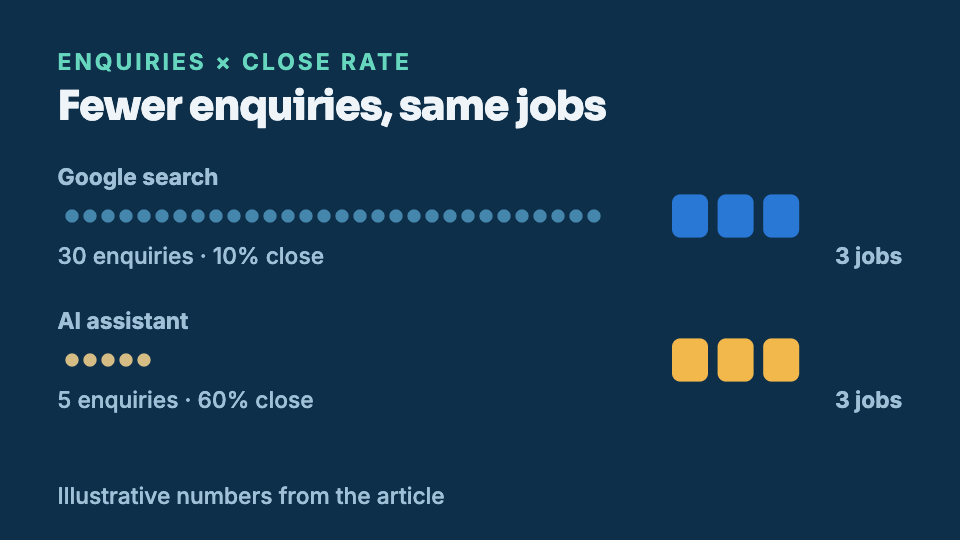
- A small channel can be worth more. Five enquiries a month at a 60% close rate can be worth more than thirty at 10%.
- You can see where enquiries come from. Ask new customers how they found you, watch for visits from chat.openai.com and perplexity.ai, and track searches for your business name.
- Count enquiries and jobs by channel instead of raw traffic. A falling visitor count from search often means the same or a better number of customers, arriving by a different door.
Want to know where your business stands? Our Standard Audit reads up to 40 pages of your site, checks up to 300 Google searches you already show up for, sets you against up to three local competitors, and shows what ChatGPT says when customers ask up to 5 questions. A$149 one-off, delivered in two business days, no access to your site needed.
Get my Standard AuditFewer visitors is the whole point
A Google search hands you a page of ten options and lets the visitor do the comparing. An AI assistant does the comparing first and hands the visitor two or three names, already filtered by the questions it asked on their behalf: who is nearby, who has the right reviews, who actually does the job being described. By the time that visitor reaches your site, most of the decision is already made. They are not browsing. They are checking the one detail the assistant could not answer for them, usually your price, your availability, or a way to contact you.
That is a smaller number of visitors doing a more advanced job than most Google traffic ever does. Judging it by volume alone measures the wrong thing.
A simple way to work out what it is worth
You do not need special tools to estimate this for your own business. Three numbers do it: how many enquiries you get from a channel in a month, what share of those actually become paying jobs, and what an average job is worth. Multiply an enquiry count by a close rate and by a job value, and you get a rough figure for what that channel is worth to you per month.
Run the same formula against your AI-referred enquiries and your Google-referred enquiries separately, and compare not the enquiry count but the number that falls out the other end. A channel that sends you five enquiries a month at a 60% close rate can be worth more than one sending you thirty at 10%, and the volume figure alone would tell you the opposite.
Why the higher close rate is not a coincidence
It follows from what an assistant is actually doing before it names you. It has already checked that your service area covers the customer, that your reviews hold up, and that you plausibly do the job being asked about. A visitor who arrives after that filtering has fewer reasons left to walk away. A visitor who arrives from a general search has not been filtered at all, and a share of them will click through and discover you are not what they were after.
How to actually see where an enquiry came from
None of this is useful if you cannot tell your channels apart. Three ways, roughly in order of effort. Ask new customers how they found you and log the answer, even informally. Watch your analytics for referral traffic from chat.openai.com, perplexity.ai and similar, though this only catches visitors who click through rather than acting on the answer alone. Track your branded search: a rise in people searching your business name directly often follows being named in an AI answer, even when no click ever gets attributed to it.
A channel that sends nobody your way is worth zero, whatever its potential close rate looks like on paper. Being named at all is the number that has to move first, and the value only shows up once it does.
What to actually measure going forward
Sessions and click counts were built for a web made of ranked lists, where more visitors reliably meant more chances at a sale. That assumption gets weaker every time an assistant sends you three qualified visitors instead of thirty browsing ones. Track enquiries and jobs by channel instead of raw traffic, and a falling visitor count from search stops looking like a crisis and starts looking like what it usually is: the same or a better number of customers, arriving by a different door.
Before any of this matters, an assistant has to name you at all. If you are not sure how often that is happening, our guide on how Australian businesses get found in AI search covers what decides that, and an AI visibility audit tells you exactly where you stand today, before you spend anything working out what a mention would be worth.
Keep reading
What AI visibility work actually costs in Australia
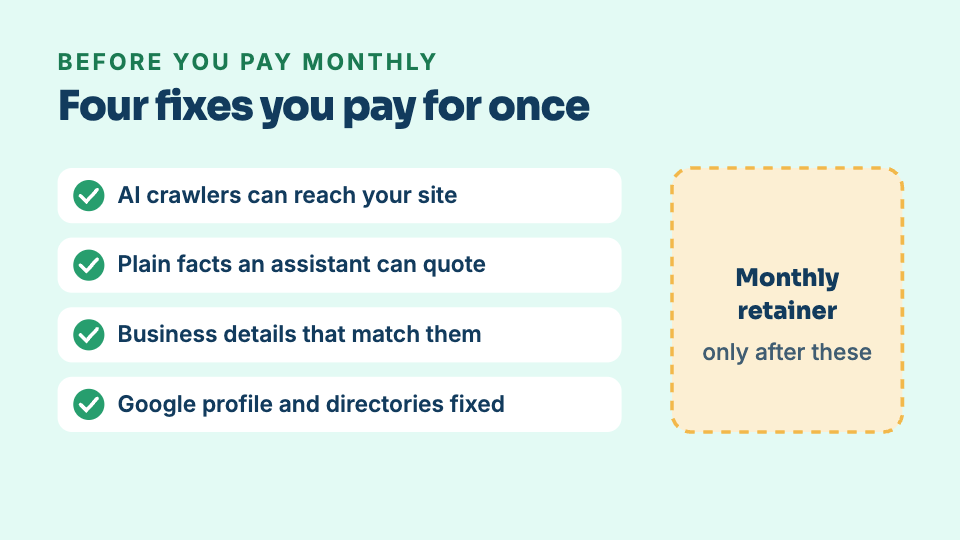
Ask what AI-visibility work costs and most agencies want a conversation first, not a number. Here is what a retainer actually buys, the fixes worth doing before you ever sign one, and how to tell a real quote from a vague one.
How Australian businesses get found in AI search
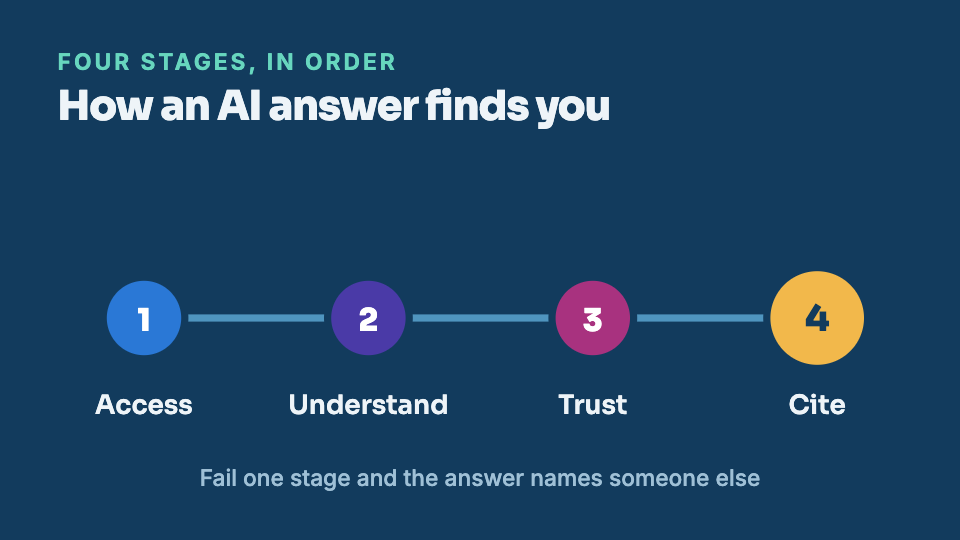
Search is splitting in two. Google still lists links, and a growing share of customers now get a single spoken answer from ChatGPT, Gemini or Perplexity instead. Here is what decides whether that answer names you.